Mistress Margaret Thacher of Boston had an interesting role in the Salem witch trials.

Margaret Thacher Home, Site of

Devonshire, Court and Washington Street, Boston, MA
Devonshire, Court and Washington Street, Boston, MA
More About Margaret Thacher Home, Site of
Mistress Margaret Thacher (alternately spelled Thatcher) a wealthy Boston widow, played an intriguing role during the Salem witch trials. She lived in the heart of Boston, near the town house, jail, and Dock Square. She was accused of witchcraft herself, possibly by a disgruntled servant, but was never arrested. Another of her servants became afflicted after a visit to an imprisoned “witch” and her story was recounted by Rev. Cotton Mather. And Mistress Thacher was the mother-in-law of one of the principal judges on the Court of Oyer and Terminer.
Baptized in 1625, a daughter of Henry and Clement (Ruddyfer) Webb, Margaret married Jacob Sheaf in Boston circa 1642. It is unclear when she came to Massachusetts. Sheaf died in 1659, leaving Margaret a wealthy woman. Her father Henry died shortly thereafter, adding to Margaret’s wealth. Margaret and Jacob’s daughter Elizabeth, first wed in 1660 to Robert Gibbs, married for the second time in 1669, to Salem magistrate Jonathan Corwin.
Five years earlier, in 1664, widow Margaret Sheaf had married her second husband, Rev. Thomas Thacher. She was Thacher’s second wife. Rev. Thacher led the Weymouth, MA congregation for twenty years, relocating to Boston when he remarried. In 1669, he became pastor of the Third Church (aka the Old South Meeting House) where he continued until his death in 1674. Margaret remained a widow for the rest of her life. She died in 1694 and was buried with her first husband, Jacob Sheaf, in King’s Chapel Burying Ground.
Not one, but two of Mistress Thacher’s servants may have played roles in the witchcraft hysteria. The first account comes from historian Marilynne Roach, who describes charges against Bridget Denmark in February of 1692. Denmark was in court, charged with stealing £5 worth of goods from Thacher, including cups, handkerchiefs, gloves, and a ring. Says Roach, “The young woman, a Maine refugee, had been tried in September for drowning a man in the mud and water off a Boston dock.” Denmark was found guilty of accidental manslaughter and fined £20 plus jail costs. Roach speculates that, because Denmark was free (and stealing from Thacher) in December, her fees may have been paid by Mistress Thacher in exchange for her work. Months later, in May of 1692, notes Roach, “Mrs. Thacher was not only embroiled in property disputes and plagued with a larcenous servant, but was also accused of bewitching the afflicted. Her own maid, perhaps Bridget Denmark, had confessed to witchcraft and probably accused her mistress.”
Another of Thacher’s servants, Mercy Short, played an even more dramatic part in the trials. Captured and marched to Canada after the Salmon Falls Massacre in 1690, in which her parents and several siblings were killed, Short was “redeemed” and returned to Boston months later. Historian Mary Beth Norton makes a convincing argument that it is Short who, now one of Thacher’s servants, was dispatched to Boston jail in 1692 to run an errand of mercy – likely bringing food and clothing to Mary English, accused of witchcraft. While there, Short was asked by Sarah Good, also incarcerated for witchcraft, for some tobacco. Short picked up some shavings from the filthy floor, flung them at Good, and said, “there’s tobacco good enough for you.” Good responded with anger, and Short claimed to become afflicted as a result. Mercy’s troubles continued, off and on, until the spring of 1693. The city of Boston was intrigued with her afflictions – was she tormented by demons? Or was she faking her symptoms? The entire affair was chronicled by Rev. Cotton Mather in “A Brand Pluck’d Out of the Burning.”
Mistress Thacher made another important appearance in the annals of the witch trials. Wealthy Boston merchant, mathematician, and astronomer Thomas Brattle wrote a now-famous letter critical of the trial proceedings in October of 1692. In it, he not only questioned the wrongful convictions and executions of innocent people but questioned why, when certain wealthy people were accused, were they not also prosecuted? He said, “I do admire that some particular persons, particularly Mrs. Thatcher of Boston, should be much complained of by the afflicted persons, and yet that the Justices should never issue out their warrants to apprehend them … although the said Mrs. Thatcher be mother-in-law to Mr. Corwin, who is one of the Justices and Judges, yet if Justice and conscience do oblige them to apprehend others on the account of the afflicted their complaints, I cannot see how, without injustice and violence to conscience, Mrs. Thatcher can escape, when it is well known how much she is, and has been, complained of.” Thacher was not the only elite person of wealth that Brattle mentioned, but it is curious that, in the existing trial records, there is very little mention of her. And yet, by Brattle’s telling, it was well-known that she had been accused and, it seems, frequently. Perhaps her money and connection to one of the judges kept her name (almost) free of the written accounts.
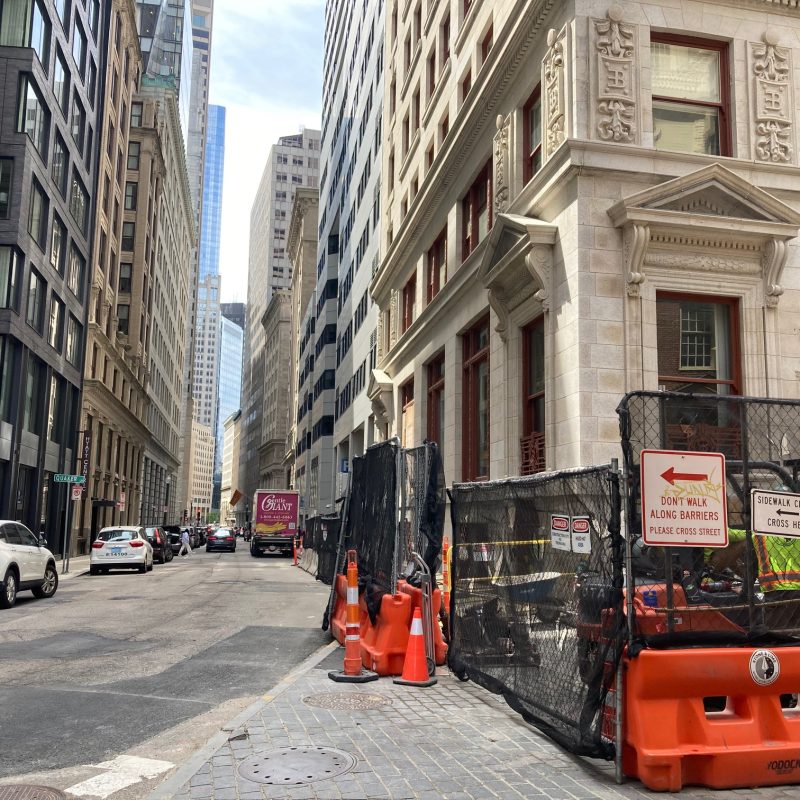
Margaret Thacher lived in the heart of Boston, near what was then Dock Square, close to the jail and the town house. Today her neighborhood is bordered by Washington, Devonshire (formerly Pudding Lane), and State Streets (formerly King Street).